
Heat Pump News
CCC writes to PM
The Committee on Climate Change has written a powerful letter to the Prime Minister on 18 December to emphasise the urgency of the UK coordinating action to reduce climate change ahead of the UN Climate Summit in Glasgow in November 2020.
What is "Possible"?
Possible is a charity that proposes that the heat absorbed by the ground in public parks in summer should be transferred to buildings in winter using ground source heat pumps.
Electrification of Heat Demonstration Project
BEIS has announced its Electrification of Heat Demonstration Project to raise acceptance and support wider deployment of heat pumps in Great Britain. £16.5m will be made available to demonstrate the practical and technical feasibility of heat pumps.
Roadmap for the Role of Heat Pumps
This new Roadmap for Heat Pumps report, written by Ecuity under the supervision of the HPA, highlights the role that heat pumps can play in the decarbonisation of heating.
"Our house is on fire"
Greta Thunberg speaks at the World Economic Forum in Davos and says "Our house is on fire", it is time for action, we do need to panic.
Philip Hammond bans fossil fuels for heating
The Chancellor bans the use of fossil fuels for heating in new homes from 2025.
Net Zero by 2050
The Climate Change Committee recommends a new target for the UK to reach Net Zero carbon emissions by 2050.
The Prime Minister agrees to Net Zero carbon emissions by 2050.
Heat Pumps and DSM
You are invited to the Heat Pumps and Demand Side Management seminar, which is being held on 7 November at The Building Centre, Store Street, London from 10am to 4pm.
Heat Pumps in London
The GLA has commissioned a study into the implications of a widespread uptake of heat pumps in London's new developments, driven by the decarbonisation of the electricity grid: Heat Pumps in London.
PAC reports on the RHI
The Public Accounts Committee published its critical Report on the RHI on 16 May 2018.
National Audit Office reports on RHI
The NAO report published on 23 February 2018 finds that take-up of the RHI scheme has been "much lower than originally anticipated".
Some 80,000 installations have been delivered by the RHI by December 2017. At current rates of take-up, the NAO estimates the RHI will achieve around 111,000 new installations by March 2021, just 22% of the original target of 513,000 by this date.
The NAO said the government needed to increase renewable heating rates in order to meet statutory carbon targets.
Clean Air Strategy
DERFA has published its Clean Air Strategy with the aim of reducing air pollution from combustion.
CO2 Concentration hits 403.3 ppm
The average concentration of CO2 in the atmosphere rose to 403.3 parts per million in 2016, up from 400 ppm in 2015. This is the highest level seen for over 800,000 years according to the World Meteorological Organization. See BBC report.
Carbon Calculator and GridWatch
The GridWatch website shows you where UK electricity is currently generated from.
The HPF CO2 emissions calculator shows how much lower carbon emissions are form heat pump heating systems than from combustion-based heating systems for each kilowatt hour of heat delivered.
Clean Growth Strategy
BEIS has published its long awaited Clean Growth Plan as a Clean Growth Strategy
Committee on Climate Change urges Government action on reducing climate change
The Committee on Climate Change published its report on "Next Steps for UK Heat Policy" on 13 October 2016. It is urging full hearted support for heat pumps and also for the Government to consider the conversion of the gas grid away from natural gas towards distributing hydrogen and a massive investment in Carbon Capture and Storage.
Heat Pumps in District Heating
DECC has published Heat Pumps in District Heating, a report which recognises the value of using heat pumps in District Heating in place of gas boilers and gas-based CHP to lower carbon emissions.
Paris Agreement limits Climate Change
On 12 December at the United Nations Conference nearly 200 countries came together in Paris and agreed that carbon emissions should be reduced with the aim of limiting the increase of temperatures to 1.5°C above the temperature of pre-industrial times. See Paris Agreement. This is good news for the world - and will be good news for members of the HPF if DECC takes genuine steps to limit carbon emissions from heating.
Does DECC yet recognise that Ground Source Energy and recycling heat through the ground is the surest route to saving energy and reducing carbon emissions from heating? How will DECC respond to this new challenge?
Comprehensive Spending Review
On 25 November the Chancellor confirmed in the Comprehensive Spending Review that funding for the RHI would continue beyond March 2016 up to 2020/21. This follows extensive lobbying by the HPF and a number of its member companies: the future looks more secure.
Importance of Strategic Heat Policy
The HPC, along with other trade associations, has written to Amber Rudd to encourage her support for the RHI ahead of the Comprehensive Spending Review: Importance of Strategic Heat Policy.
Ground Source Energy Expo 2015
The Ground Source Energy Expo 2015 held at the Ricoh Arena in Coventry was a big success with twice the number of visitors than came to last year's event. Visitors came to learn about developments in the GSHP market, both domestic and commercial. The presentations can be viewed at Ground Source Energy Expo 2015.
Reduced rate VAT – Warning – EU Judgement of 4 June 2015
DECC responds to the consultation
DECC responds to the consultation returns on "Renewable Heat Incentive: providing certainty, improving performance" on the non-domestic RHI and at the same time confirms that RHI tariffs for non-domestic RHI are being reviewed and the anticipated changes will be backdated to 21 January 2013.
Solar Roads Systems for cycle tracks
The Dutch are planning to make their cycle lanes ice-free by using ground source energy: warm roads melt ice.
BGS sharpens its tools
The British Geological Survey has developed an open loop screening tool in conjunction with the Environment Agency to assess whether your postcode is likely to sitting above a suitable aquifer for a large open loop GSHP system. You can find explanations, and the new tool itself, on the GSHP page of the BGS website.
BGS contributes to ThermoMap
The British Geological Survey is the UK member of the EC co-funded ThermoMap project which focuses on the mapping of very shallow geothermal energy potentials in Europe.
See the latest ThermoMap Newsletter which leads you to ThermoMap where you can see what they know about the potential for heat collection from horizontal collectors in the soil in your area.
The ThermoMap does not aim to inform about the geology of your area for the purposes of drilling a borehole for ground source energy. However, you can go directly to BGS for this information.
What will happen to the price of gas in future?
The price of gas has risen in the past, is rising now and is likely to continue rising in the future. The increase in world population will put increasing pressure of demand on gas - and other natural resources. The price of electricity tends to rise in line with the cost of gas.
What is the alternative to using gas for heating?
A heat pump provides gas-free heating.
Grid Carbon Factors fall steeply
Grid Carbon Intensity has fallen by half since 2014 and BEIS projects continuing falls into the future:
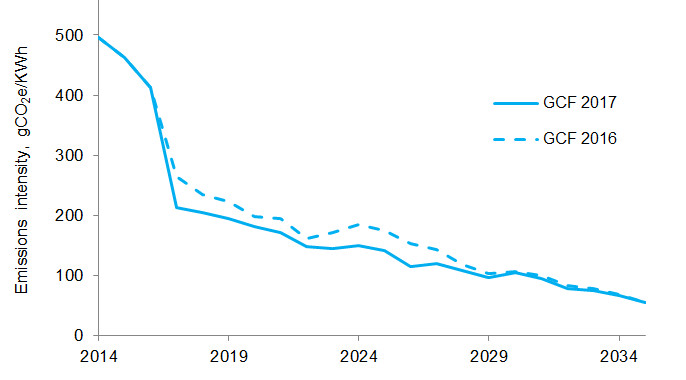
SAP 10.1 acknowledges grid carbon at 136
SAP 10.1 published on 10 October 2019 acknowledges a grid carbon factor of 136 grams CO2e/kWh. See SAP 10.1.
Scotland backs GSHPs with cash
The Scottish government is backing the installation of GSHPs in social housing with cash: Scotland backs GSHPs with cash
Groundwater Source Heat Pumps
CIBSE has launched a Code of Practice on Groundwater Source Heat Pumps in conjunction with the Heat Pump Association and the GSHPA. The Training & Standards Committee of the GSHPA has made a major input to the document.
UK Housing: fit for the future?
The Climate Change Committee has published its report UK Housing: fit for the future? The CCC concludes that government needs to take urgent actions to decarbonise the heating of the UK housing stock.
Heat Networks Investment Project
Triple Point Heat Networks is now ready to accept applications for the £320m Heat Networks Investment Project for both public sector and private sector grants for new or extended district heating networks in February 2019 on behalf of BEIS.
Four Hottest Years on Record
The last four years have been the four Hottest Years on Record. What are we going to do about it?
Heat Roadmap Europe
The European Heat Pump Association has been involved in the Heat Roadmap Europe project which provides a wealth of statistics on heating and cooling systems across European countries.
Large Heat Pumps in Europe
The European Heat Pump Association is proud to present its new publication on Large Heat Pumps in Europe, which includes examples of 16 projects showing how heat pumps can be efficient and effective in large projects.
It is interesting that none of the examples is in the UK. However, one of the GSHPA's members has provided ammonia based heat pumps to one of the largest examples shown.
Ofgem's Insights - Decarbonisation of Heat
Ofgem has just published its insights into The Decarbonisation of Heat, including the need to focus on "electrification of heating through heat pumps".
10% of UK electricity is used for Cooling
The BRE Study on energy use by Air Conditioning reports that 10% of UK Electricity use is for Air Conditioning and Cooling. However, there is a much better way to provide Renewable Cooling.
Heat Roadmap Europe
The European Heat Pump Association has been involved in the Heat Roadmap Europe project which provides a wealth of statistics on heating and cooling systems across European countries.
Ofgem's Insights - Decarbonisation of Heat
Ofgem has just published its insights into The Decarbonisation of Heat, including the need to focus on "electrification of heating through heat pumps".
10% of UK electricity is used for Cooling
The BRE Study on energy use by Air Conditioning reports that 10% of UK Electricity use is for Air Conditioning and Cooling. However, there is a much better way to provide Renewable Cooling.
Zero Carbon Homes applies in London
Zero Carbon Homes rules apply in London from 1 October 2016. See Zero Carbon Homes - London.
Domestic RHI Biomass rates fall 20%
DECC announced a 20% decrease in RHI for new biomass domestic installations from 10.98p to 8.93 from 1 April 2015. This follows on from the 10% decrease from 12.2 to 10.98p in the previous quarter. See Biomass degressions.
MCS Guidance on domestic renewable heating threshholds
MCS has published guidance on how to apply the revised thresholds for MCS installations. These apply for installations since 16 December 2013. Although only individual heating appliances of up to 45 kWth can gain MCS certification, MCS certified installers can design, install and certify systems with a heat demand of up to 70 kWth by using more than one certified appliance. An MCS installer who can demonstrate competency may also install multiple MCS installations of up to 70 kWth within a given property: and it may not be necessary for these multiple areas to be hydraulically separated.
Ofgem opens for Domestic RHI
On 9 April 2014 Ofgem opened its servers for Domestic RHI applications. Six years after the Energy Act 2008, it is possible to make an application to Ofgem to receive RHI for domestic applications to support the costs of renewable energy technologies installed since 15 July 2009. See RHI Domestic. Owners of domestic properties installing ground source heat pumps can now receive rewarding financial returns as well as a green heating system.
RHI rates expected to double
Following the meeting with HPF Coucil members in December, DECC issued its Announcement on 21 January 2013.
DECC has confirmed that "evidence suggests there may be differences between actual costs and load factors of installations and the original assumptions used to calculate the current tariffs" clearly indicating that the early assumptions needed revisiting.
The HPF evidence submitted supports an increase of tariff rates to 9.4p/kWh.
The DECC announcement goes on to confirm that, "It is DECC's intention that where tariffs increase as a result of this work, installations accredited from today (21 January 2013) would benefit from that increase once the new tariffs come into force".
See RHI GSHP rates expected to double
DECC £6m scheme for social housing
DECC announces a £6m scheme for social housing.
Unfortunately the RHI is failing badly on all these counts - indeed the RHI is currently operating to frustrate these objectives.
The tariff levels for large GSHP installations are currently less than half the rate for biomass boilers and the calculations include major errors in the calculations that supress the GSHP tariffs.
The Minister encouraged officials to accelerate the review of the GSHP tariffs and is expecting to announce that changes in tariffs will to be corrected with an announcement from the Minister in the second week of January.
Ofgem accredits GSHC installations
Although the commercial RHI began on 28 November 2011, it has taken over a year for Ofgem to commernce accreditation for Ground Source Heating and Cooling ("GSHC") installations.
After many months of HPF lobbying of DECC and Ofgem, Ofgem wrote to the HPC and other stakeholders on 5 December 2012 to say that owners of GSHC systems will be entitled to receive RHI, but at a discounted rate. Owners of systems up to 100kW rated capacity will receive RHI at 72.3% of the RHI rate for ground source heat pumps. Owners of systems over 100kW rated capacity will receive RHI at 64.73% of the RHI rate for ground source heat pumps.
For more see Ofgem starts accrediting GSHC.
EGEC calls for action
The European Geothermal Energy Council has called for an EU action plan on renewable heating and cooling in order to assess the major bottlenecks hindering the further development of ground source energy in Europe: EGEC Press Release.
The EU Energy Commissioner Günther Oettinger says that "geothermal will play an important role in the future energy mix of the EU" and that "we should encourage geothermal development in more and more cities".
Philippe Dumas, Manager at the European Geothermal Energy Council, pointed out that "policy-makers, local authorities and utilities need to be more aware of the full range of geothermal resources available and of their possible applications".
Vertical Borehole Standard
The HPC's Vertical Borehole Standard which covers the design, installation and testing of closed-loop vertical boreholes was published in September 2011. The HPC's Thermal Pile Standard was published in September 2012.